 I joined Rachel Harrie’s platform-building campaign a couple of months ago. It has been a great way to get to know other fiction writers, who have turned out to be a supportive and fascinating bunch. Rachel kept things interesting by holding flash fiction writing challenges, which encouraged everyone to visit each other’s blogs and share samples of their writing.
The first challenge inspired me to write The Rune, for which I’m thankful. Writing that short fiction piece got me thinking about how symbols might play a role in the magic system I developed for my Vaetra Chronicles series. I figure that incantations need to be recorded somehow, and runes would be an interesting way to do it. As is often the case, my mind went on a “what if” journey to explore the possibilities.
Runes: The Written Language of Magic
What if using widely recognized runes/symbols made the recorded incantation stronger than if you used symbols you invented yourself? What if you could record an incantation within an object, and then power that object to produce the “pre-programmed” manifestation? What came out of this line of thinking was the seed of an idea for how I could use runes as the written language of magic.
In particular, I liked how the concept merged with the way vaetric implements (i.e. magical devices) work in Mundia, my fantasy world. Vaetric implements have a specific incantation embedded within them. Sorcerers channel vaetra (magic) into the implement, which powers the incantation to produce the intended manifestation.
Now add runes to the mix. During my early world building, I had never fully established exactly how an incantation was applied to an implement. Using runes to do it seems like a natural and logical approach. If an incantation is constructed from runes, adding those runes to an implement would apply the incantation to the implement. [“All too easy,” he says in his best Darth Vader voice.]
Traditional or Non-traditional?
In Earth’s history, runes started off as a simple alphabet, but later they were co-opted by real-life practitioners of Magick, and new meanings were ascribed to the symbols. Runes were used for divination and fortune telling. Some Tarot card decks incorporate rune symbols.
So the next thing I needed to decide was whether or not I would adopt some or all of the traditional meanings for runes, or if I would invent my own symbols. After researching the subject, I decided that traditional runes did not match up with my vision for how symbols would be used to represent incantations. The traditional meanings are too vague (e.g. “luck” or “fertility”) and the rune set is too limited. What I really wanted was something more like pictograms than true runes.
 I decided to invent my own symbols, but I wanted those symbols to be standardized within a given group of practitioners in the story world. Standardization is inevitable if you have an organization that teaches sorcery, as does the Archives (a sorcerer’s retreat on Mundia). Plus, I developed a theory that standardization would actually increase the effectiveness of the symbols. The idea here is that the more people who recognize a symbol as having a specific meaning, the more powerful that symbol becomes when used for that meaning.
Semantic Affinity
I named my theory Semantic Affinity. Semantic affinity consists of two contributing factors: intrinsic and ascribed. A symbol has intrinsic semantic affinity if it looks like what it represents. If you draw a stick figure of a person and it literally means “person,” the symbol has intrinsic semantic affinity for that meaning. If you draw a figure-eight lying on its side and everyone knows that symbol means “infinity,” then the symbol has ascribed semantic affinity for that meaning.
Okay, that’s the nerdy explanation of the theory. What it means in practice is this: If you create a magical device and use widely-recognized symbols for the incantation that drives that device, your device will be far more powerful than if you record the same incantation using symbols you simply made up. Call it the power of collective consciousness, if you will.
From Theory to Practice to Story
One of the most fun aspects of writing fantasy is that you are free to invent whatever you want and work it into the story however you want. It is unlikely my readers will ever encounter the term “semantic affinity.” That would probably be Too Much Information. However, my characters will have to live within the constraints of theories like semantic affinity, and the readers will certainly see the implications of that!
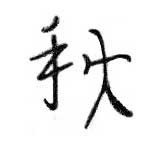
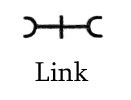
In case you are wondering, the image at the top right is the Chinese pictogram for “Autumn” (seemed appropriate, given the season). The one with the “Link” caption is one I invented for the Vaetra Chronicles.
***
What’s your favorite tool of magic? J.K. Rowling was obviously a big fan of wands. Some people really like crystal balls. Others have a fixation with magical jewelry (e.g. “one ring to rule them all”). Tell me your favorite in the comments!